Breeding Plantations
Posted on January 9, 2026
I take heart from the apparent growth of new information about American slavery—even as our nation today imprisons, deports, arrests, ships, denounces, and detains people who don’t fit the mythical American mold.
Witness the newly reimagined National Center for Civil and Human Rights in Atlanta, and the new exhibition of “Monuments” at the Museum of Contemporary Art in Los Angeles. The latter features reworked versions of Confederate statuary (notably the Robert E. Lee statue that used to dominate Charlottesville, Virginia.) I’m tempted to think history is shifting, but then I’m reminded by Kama Piere, chief program officer and curator of the Atlanta Center, that these new developments repeat “the story of Black progress and white backlash. We feel like we’re still in this cycle in this country.”
Soon after Scarlett came out, I attended an online event hosted by Coming to the Table’s Linked Descendants group. Speaker Jobie Hill, a PhD candidate at Duke University and an architectural historian, described her research into “breeding plantation.” (Readers of Percival Everett’s James may recognize the practice.) Hill’s research—drawn largely from her ongoing work at the Pharsalia Plantation in Virginia—reveals how whole plantations were once devoted to the production of children. This was especially true after the abolition of the transatlantic slave trade in 1808.
Post-1808, the need to breed children grew. Enslavers like my ancestors needed new slave labor “to build long-term sustainable wealth,” Hill told us.
“Breeding plantations” satisfied that need.
Surely the unnamed African man purchased in 1858 by my ancestor Francis Muir Scarlett from the illicit slave ship the Wanderer was part of this gruesome practice. When this African man refused to cooperate as an overseer, my ancestors rented him out to neighboring enslavers “as a producer of children for $100 a day.” The quote comes from a Scarlett who witnessed these events as a boy.
Jobie Hill’s work is indeed urgent.
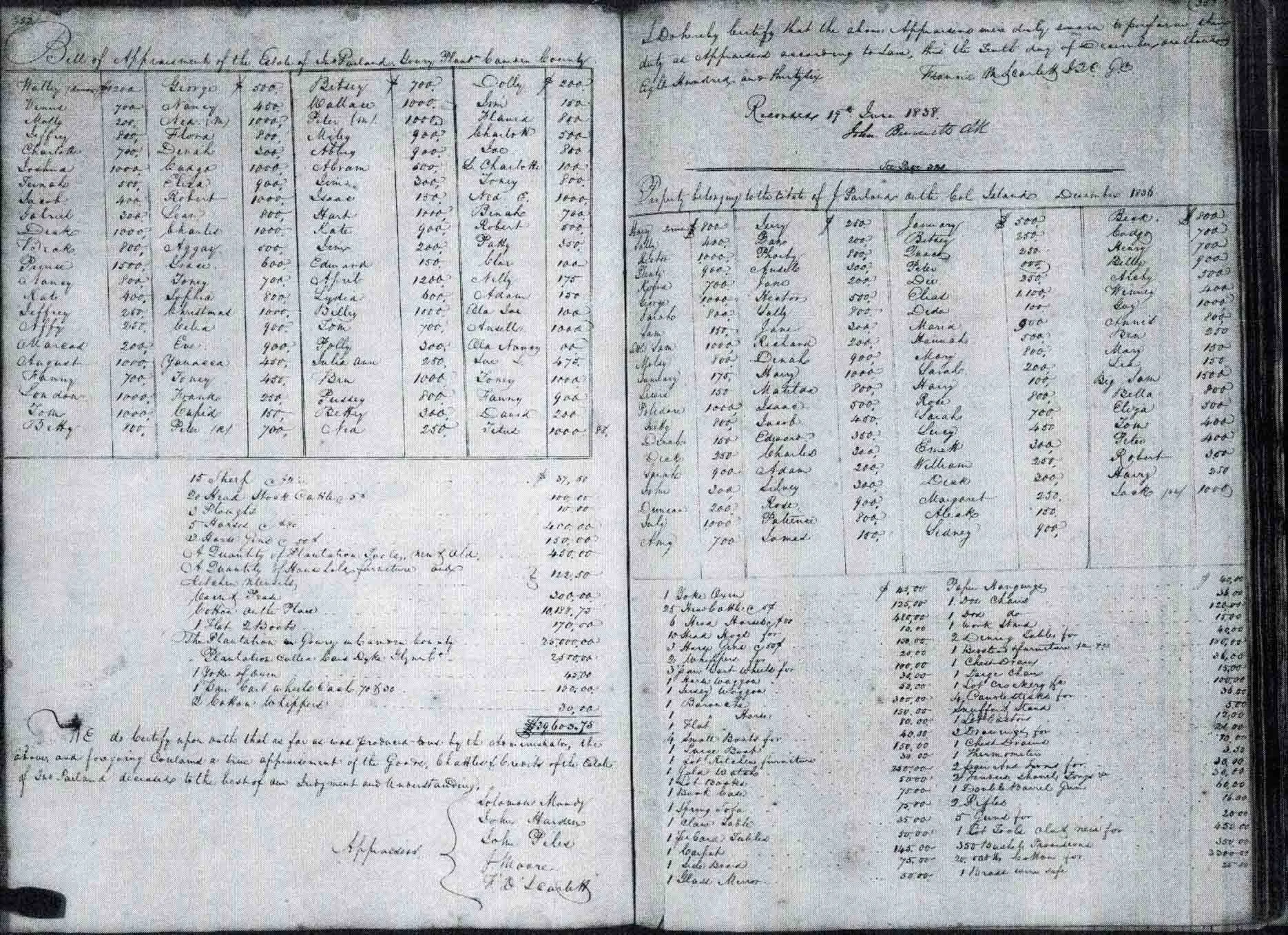
An inventory for John Parland, a white enslaver who married into the Scarlett family, and whose wealth in human captives enriched the Scarletts.